SSP 390 The 7-speed Double-clutch Gearbox 0AM
Basic principle
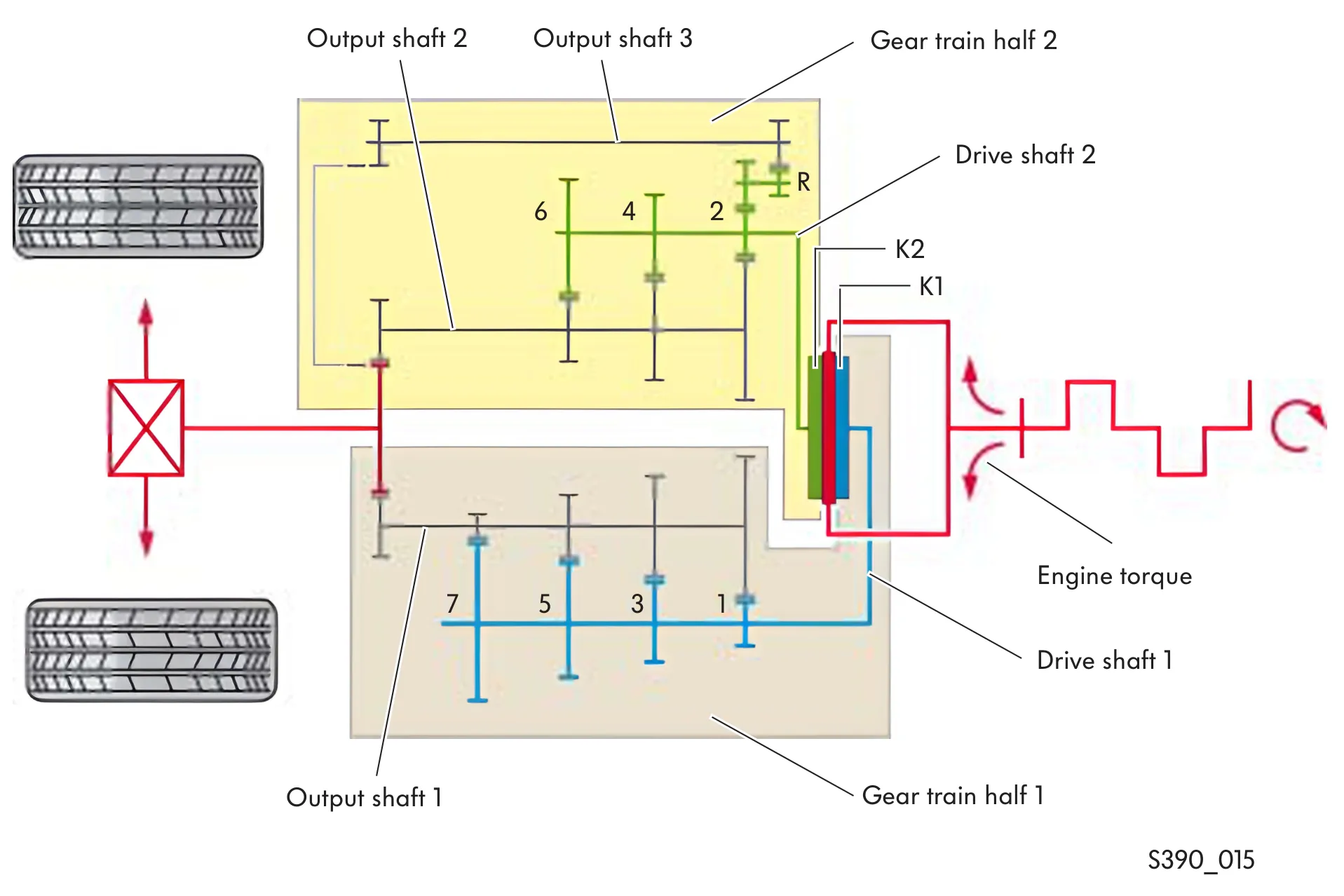
In principle, the double-clutch gearbox consists of two independent, gear train halves.
In terms of function, each gear train half is designed as a manual gearbox. A clutch is assigned to each gear train half.
The two clutches are dry clutches. They are opened and closed and controlled by the mechatronic unit depending on the gear which is to be shifted.
Gears 1, 3, 5 and 7 are shifted via clutch K1 and therefore via gear train half 1 and output shaft 1.
Gears 2, 4, 6 and reverse gear are conducted via clutch K2 and therefore gear train half 2 and output shafts 2 and 3.
One gear train half is always positively connected. The next gear can already be shifted in the other gear train half, because the clutch for this gear is still open.
A conventional, manual gearbox synchroniser and shift unit is assigned to each gear.
Principle diagram
Torque input
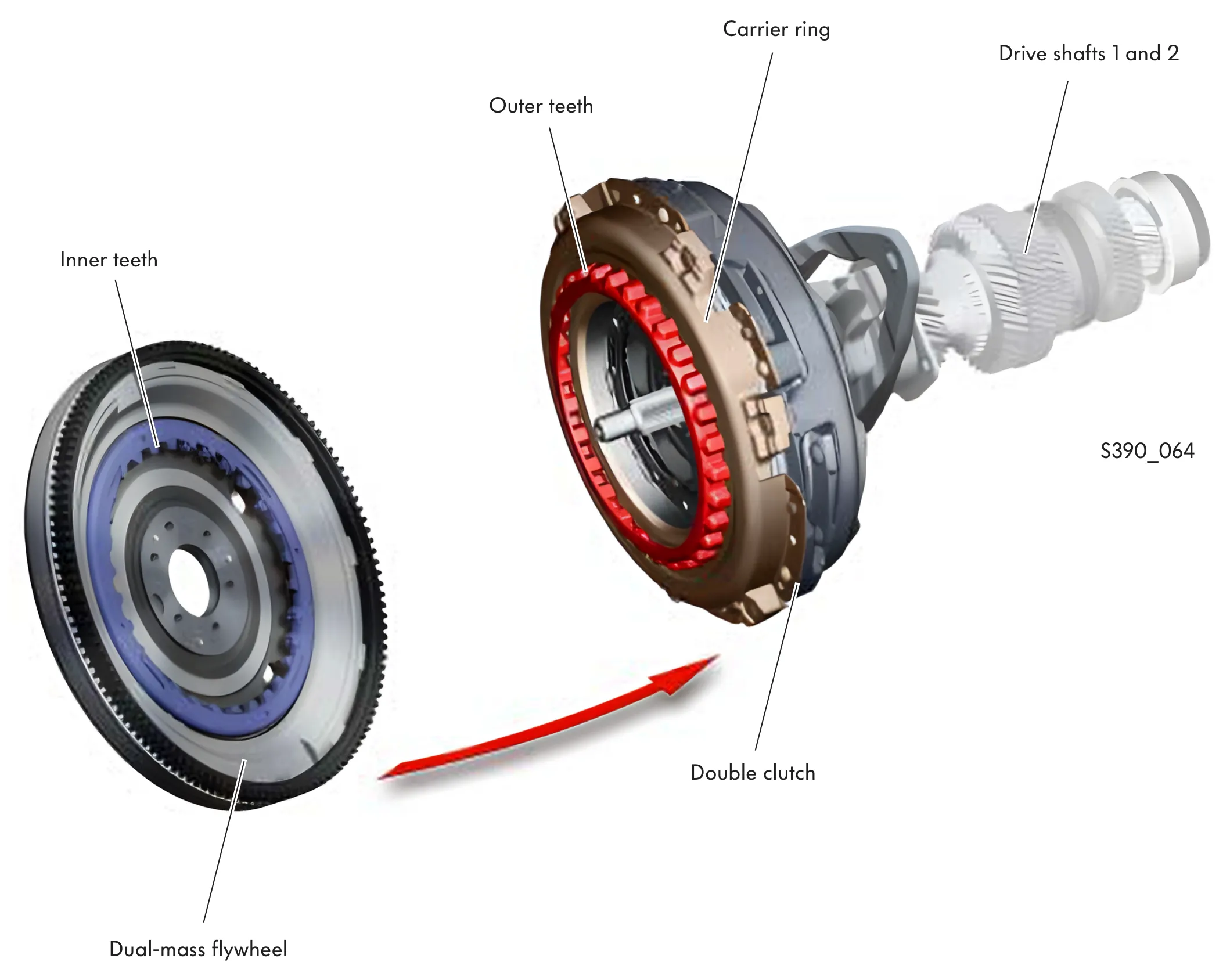
The torque is transferred from the dual-mass flywheel, which is secured to the crankshaft, to the double clutch. To achieve this, the dual-mass flywheel is equipped with inner teeth. These engage in the outer teeth on the double clutch carrier ring. From there, the torque is transmitted onwards into the double clutch.