
Running gear, axles, steering · Wheels, tyres, vehicle geometry · Vibration due to wheels/tyres – causes and rectification
Balancing wheel
⇒ 4.3.1 Balancing wheel, conditions
⇒ 4.3.2 Balancing wheel, balancing wheel on stationary wheel balancer
⇒ 4.3.3 Balancing wheel, balancing wheel with finish balancer
4.3.1 Balancing wheel, conditions
Before you start balancing the wheels, the following requirements must be met.
- Tyre pressure must be OK.
- Tread must not be worn on one side. Tread depth should be at least 4 mm.
- The tyre must not show any signs of damage, for example cuts, piercing, foreign bodies, etc.
- Wheel suspension and steering, including shock absorbers, must be in perfect condition.
- You must have conducted a road test.
4.3.2 Balancing wheel, balancing wheel on stationary wheel balancer
- Road test has been carried out ⇒ 4.2 Conducting a road test before balancing wheels.
Clamp wheel into wheel balancing machine
Dirt and rust in the area of the contact surfaces and centre of the wheel distort the result.
- Clean contact surface, centring element and inside of wheel using e.g. pneumatic brush grinding set - VAS 6446- ⇒ Volkswagen ServiceNet; Workshop Equipment, Catalogue before clamping wheel on wheel balancing machine!
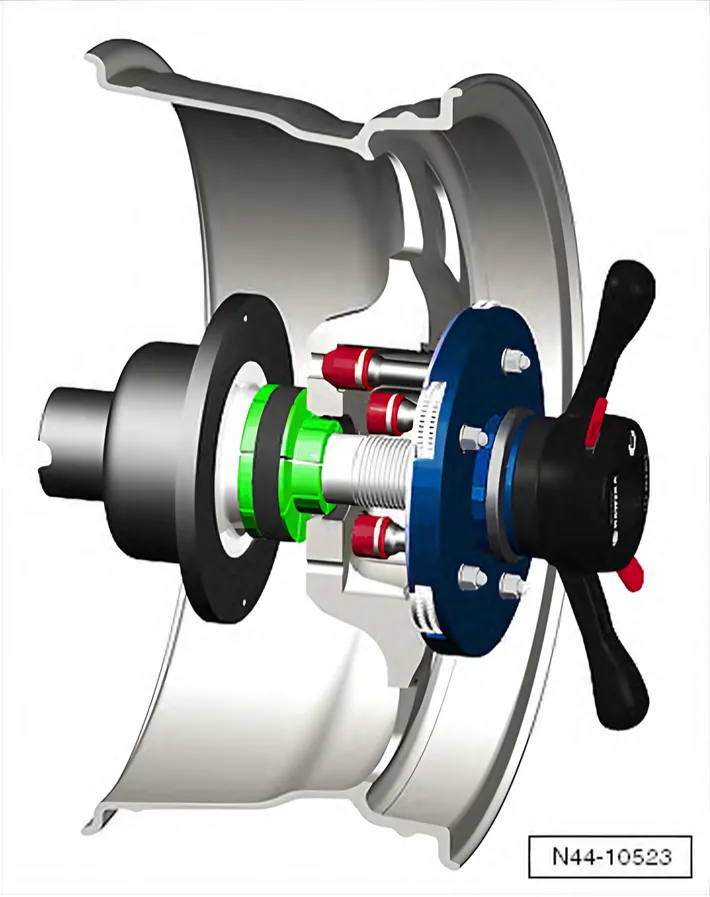
- Attach the wheel (together with tyre) to the wheel balancing machine.
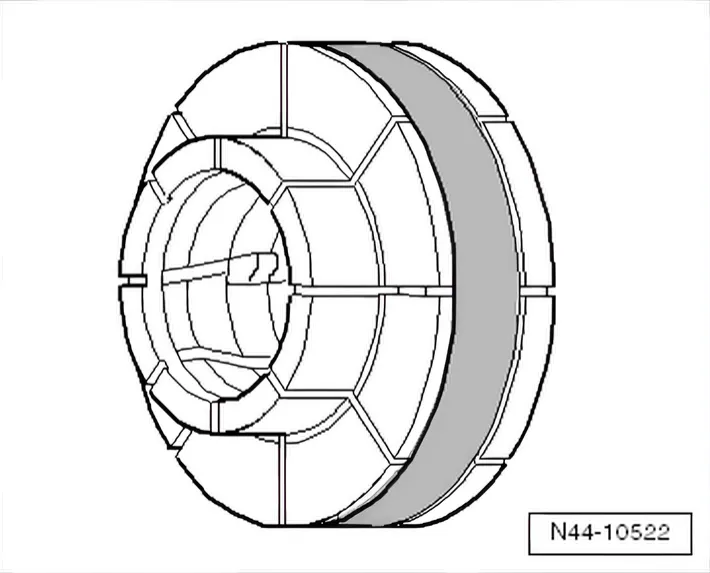
Procedure for balancing wheels and tyres
- Rotate wheel and tyre on wheel balancer.
- Check that the indicator lines on the sidewalls of the tyre near the wheel rim flange run evenly.
- Check that the tyre runs evenly while the wheel and tyre are rotating.
- Check true running of wheel/tyre. If the wheel and tyre do not run true although there are no flat spots, radial or lateral runout may be the cause.
- Check the wheel for radial or lateral run-out ⇒ 4.5.2 Checking radial and lateral runout on wheels and tyres with tyre gauge.
- If radial and lateral runout are within the specified tolerance, balance the wheel and tyre.
- Bolt wheel onto vehicle.
- First, hand-tighten the lowest wheel bolt to about 30 Nm.
- Then, tighten the remaining wheel bolts diagonally to about 30 Nm. This process centres the wheel on the hub.
- Lower vehicle onto its wheels.
- Now use the torque wrench to firmly tighten the wheel bolts diagonally to the prescribed torque.
Carrying out road test
- After balancing the wheel/tyre, carry out a road test.
If you detect vibration during the road test, it may be due to wheel centring tolerances.
In unfavourable circumstances, the component tolerances of wheels and hubs could cumulate. This too can lead to vibration. This can be alleviated using a finish balancer ⇒ Balancing wheel with finish balancer.
4.3.3 Balancing wheel, balancing wheel with finish balancer
If a residual imbalance greater than 20 g is determined when balancing the wheels, rotate the mounting position of the wheel on the hub.
- Mark the point at which the imbalance is indicated.
- Then, unbolt the wheel and rotate its position on the hub so that the marking points downwards.
- First, hand-tighten the lowest wheel bolt to about 30 Nm.
- Then, tighten the remaining wheel bolts diagonally to about 30 Nm. This process ensures that the wheel is centred properly on the hub.
- Check whether the imbalance is less than 20 g using the finish balancer.
- If necessary, loosen the wheel bolts again.
- Rotate wheel relative to hub by one or two more wheel bolt holes.
- Tighten wheel bolts using the method described above.
- Balance wheels if imbalance is less than 5 grams.
- Tighten wheel bolts to specified torque if you have not already done so.