
Running gear, axles, steering · Wheels, tyres, vehicle geometry · Vibration due to wheels/tyres – causes and rectification
Checking radial and lateral runout of wheels and tyres
⇒ 4.5.1 Checking radial and lateral runout of wheels and tyres, tolerances
⇒ 4.5.2 Checking radial and lateral runout on wheels and tyres with tyre gauge
4.5.1 Checking radial and lateral runout of wheels and tyres, tolerances
Radial and lateral runout occur when the wheel and tyre do not run absolutely true.
For technical reasons, 100% true running is not possible.
Therefore, the manufacturers of these components allow a precisely determined tolerance.
Aligning the tyre in an unfavourable position on the wheel can cause the maximum allowed tolerance for wheel with tyre to be exceeded.
The table shows the maximum permissible tolerances for a wheel with mounted tyre.
Tolerances for radial and lateral runout of rim with tyre
| Wheel with tyre | Radial runout (mm) | Lateral runout (mm) |
| Passenger car | 0.9 | 1.1 (1.3 in vicinity of lettering) |
4.5.2 Checking radial and lateral runout on wheels and tyres with tyre gauge
Checking lateral run-out
- Preload tyre gauge approx. 2 mm.
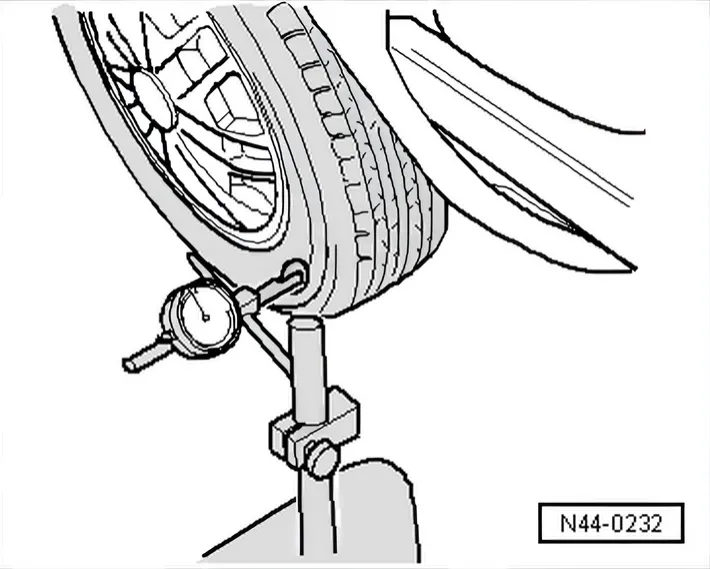
- Fit tyre gauge to side wall of tyre.
- Slowly rotate the wheel.
- Note the smallest and the largest dial readings.
In this case, you can reduce lateral runout by match mounting the tyre ⇒ 4.7 Matching wheels and tyres.
Extreme values on the tyre gauge due to small irregularities in the rubber may be disregarded.
Checking radial runout
- Preload tyre gauge approx. 2 mm.

- Set the tyre gauge against the tyre tread.
- Slowly rotate the wheel.
- Note the smallest and the largest dial readings.
In this case, you can reduce radial runout by match mounting the tyre ⇒ 4.7 Matching wheels and tyres.