Special tools and workshop equipment required
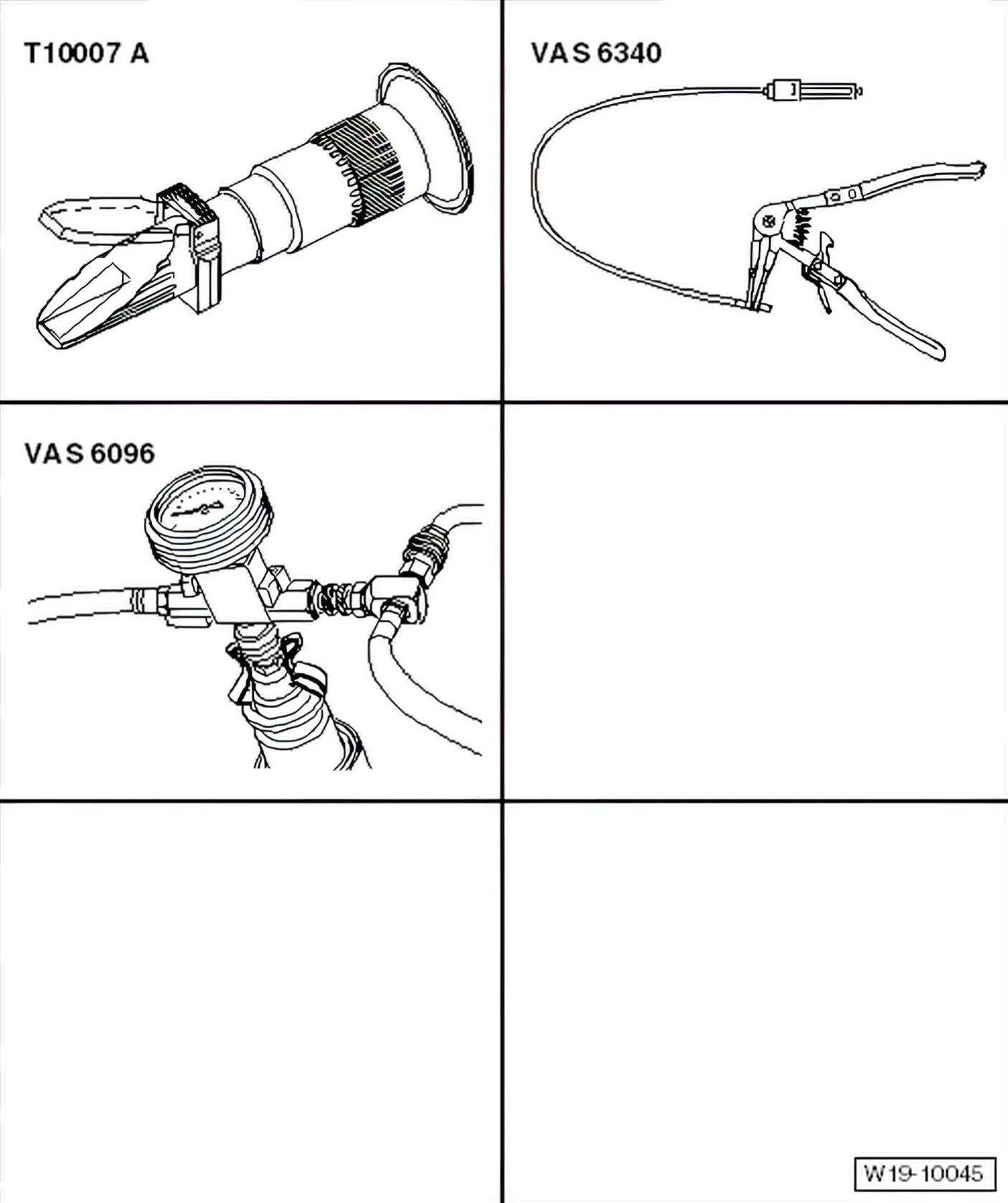
Refractometer - T10007 A- Hose clamp pliers - VAS 6340- Coolant system charge unit - VAS 6096- Draining
Warning
Hot steam may escape when expansion tank is opened. Wear protective goggles and clothing to avoid eye injuries and scalding. Cover cap with a cloth and carefully open.
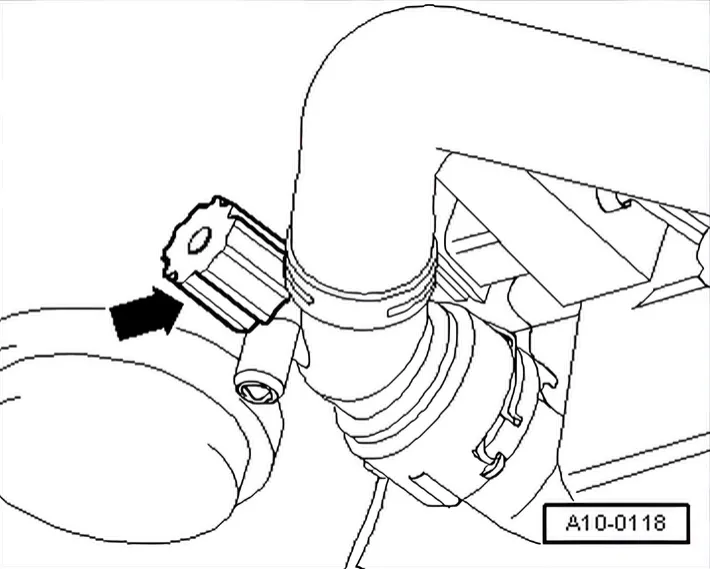
Open filler cap on coolant expansion tank. Remove engine splash protection. To drain coolant from radiator, open drain plug -arrow-. Filling
Caution
Only distilled water may be used for mixing coolant additives. The use of distilled water ensures optimum protection against corrosion.
Note
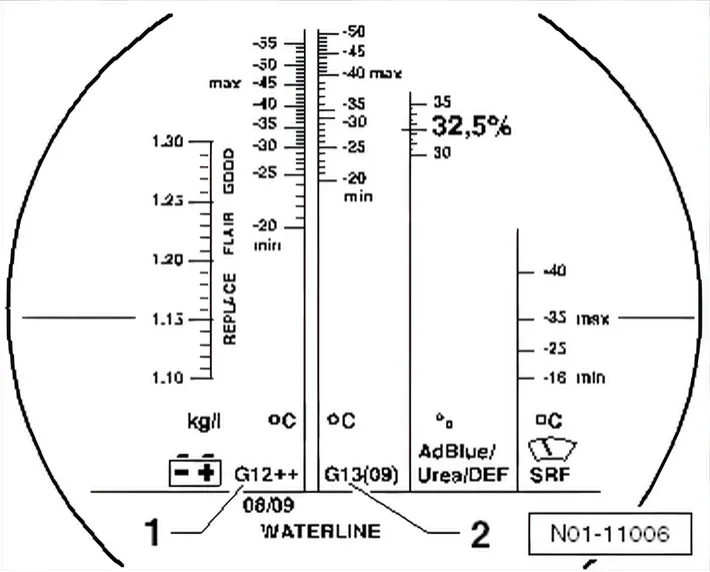
The water used for mixing has a major influence on the effectiveness of the coolant. Because the water quality differs from country to country and even from region to region, the quality of the water to be used in the cooling system has been specified by Volkswagen. Distilled water satisfies all requirements. It is therefore recommended to use distilled water when mixing coolant for topping up or replacing coolant. Use only coolant additives which conform with the ⇒ Electronic parts catalogue (ETKA). Other coolant additives may reduce corrosion protection substantially. The resulting damage could lead to loss of coolant and subsequent severe damage to the motor. Mixed in the proper proportions, coolant inhibits frost and corrosion damage as well as scaling. Such additives also raise the boiling point of the coolant. For this reason, the cooling system must be filled all-year-round with coolant additives. Because of its high boiling point, the coolant improves engine reliability under heavy loads, particularly in countries with tropical climates. ONLY refractometer - T10007A- may be used for determining current anti-freeze value. Frost protection must be guaranteed down to -25°C as a minimum and, in countries with arctic conditions, down to approx. -36°C. Increasing the frost protection is permissible only if climatic conditions require stronger frost protection. It may, however, be increased only to a maximum of -48°C. Otherwise, the cooling effect will be impaired. The coolant concentration must not be reduced by adding water even in warmer seasons and in warmer countries. Frost protection must be guaranteed down to at least -25°C. Read off anti-freeze figures for respective replenished coolant additives. The temperature read off the refractometer - T10007A- corresponds the »ice flocculation point«. Flakes of ice may start forming in the coolant below this temperature. Never reuse old coolant. Use only a water/coolant additive mixture as a slip agent for coolant hoses. Recommended mixing ratios (use only distilled water for mixing):
Frost protection to Amount of antifreeze Coolant additive 5) Distilled water 5) -25 °C 40% 2.25 l 3.35 l -36 °C 50% 2.8 l 2.8 l
Screw drain plug into radiator. Install engine splash protection. With cooling system charge unit - VAS 6096-
Fill coolant circuit using cooling system charge unit - VAS 6096- ⇒ Operating instructions for cooling system charge unit VAS 6096. Without cooling system charge unit - VAS 6096-
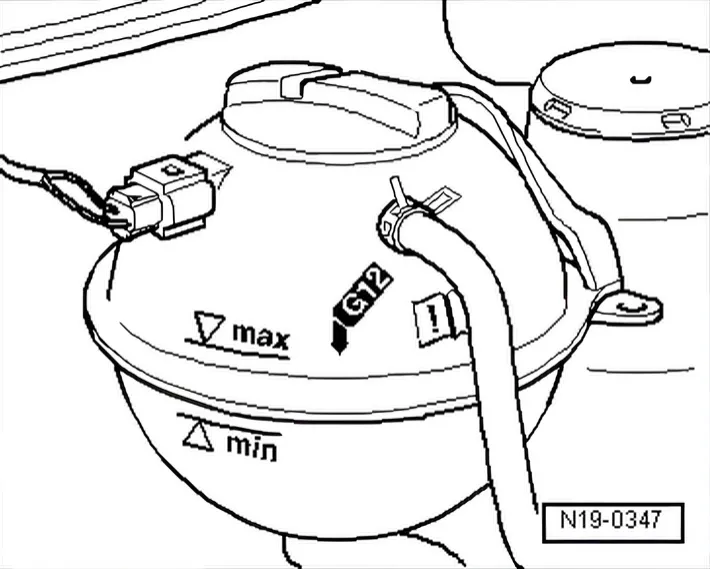
Fill with coolant up to max. mark on expansion tank. With or without cooling system charge unit - VAS 6096-
Fit expansion tank cap. Turn off heater controls. Start engine and maintain an engine speed of about 2,000 rpm for about 3 minutes. Run engine until radiator fan cuts in. Warning
Hot steam may escape when expansion tank is opened. Wear protective goggles and clothing to avoid eye injuries and scalding. Cover cap with a cloth and carefully open.
Check coolant level and top up as needed. When the engine is at normal operating temperature, the coolant level must be on the max. mark and between the min. and max. marks when the engine is cold.